
The Northeast Agenda is a collaboration between the Association of Northeast Extension Directors (NEED) and the AgInnovation Northeast (formerly the Northeastern Regional Association of State Agricultural Experiment Station Directors). It identifies challenges and opportunities for the Northeast region’s Land-grant programs as they work together to ensure a regenerative, livable, and vibrant Northeast United States.
With this agenda, we identify key priorities we can address together. The Northeast Agenda is currently being updated for 2026. Limited information on the Agenda’s high-level priorities are available below.
We invite you explore the Agenda and to engage with us. Please contact us if you have questions or want to join in this work.
- Ali Mitchell, Executive Director – NEED ([email protected])
- Rick Rhodes, Executive Director – AgInnovation Northeast ([email protected])
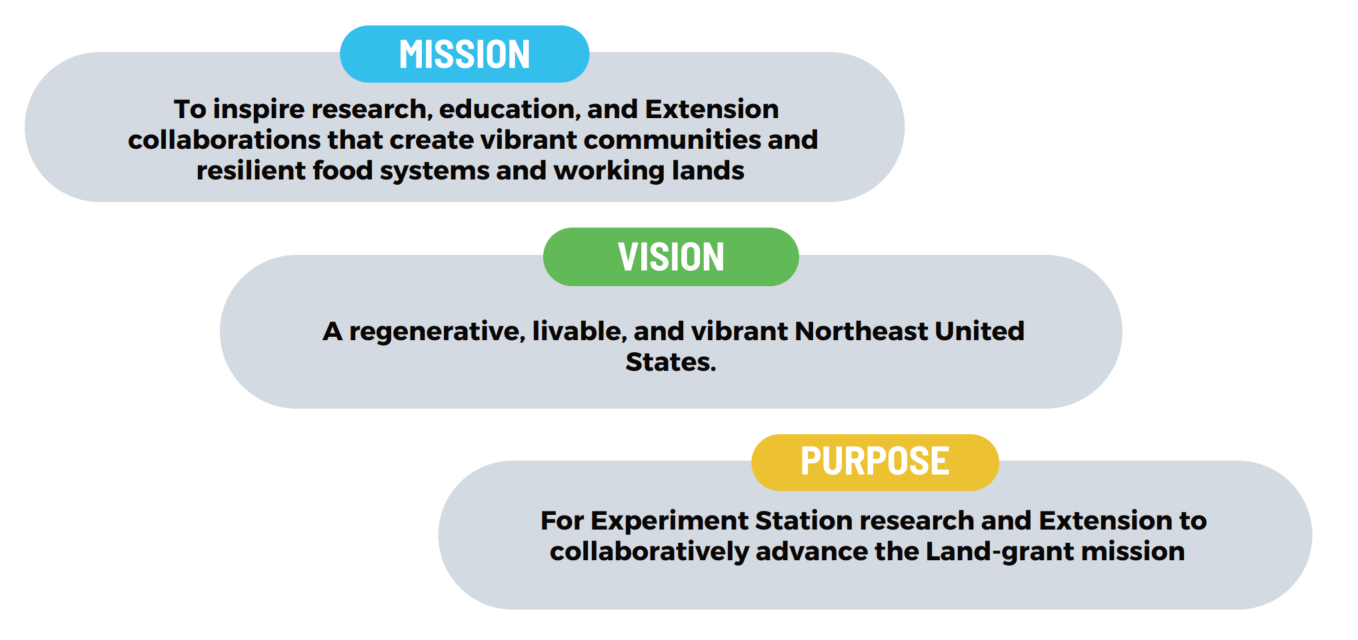
The Northeast Agenda is a living, evolving document identifying numerous challenges affecting our region and work. We hope it galvanizes our regional institutions, colleagues, and communities to create a prospectus of collaboration and investment opportunities.
Priority 1: Develop resilient and sustainable food systems.
The Northeast Region has approximately 25 million acres of agricultural land (167,000 farms). From a national perspective, the Northeast accounts for approximately 4.3 percent of total U.S. crop cash receipts and 6.3 percent of total U.S. animal and animal product cash receipts. That translates to a contribution of more than $19 billion to the U.S. agricultural economy. Although the average farm size is only 133 acres (compared to the US average of 445 acres); the productivity of those farms is high. Northeast farms generate about 2.5 times as much income per acre than farms elsewhere in the United States. Northeast farmers use their resources efficiently.
The Northeast Agenda gives special attention to:
- Innovative agriculture.
- Urban agriculture and organic agriculture.
- Specialty crops.
- Agricultural technologies.
- Controlled-environment agriculture.
- Aquaculture.
- Conventional production agriculture.
- Cultivating the next generation of our agricultural workforce.
Priority 2: Lead innovation and collaboration to enhance long-term resilience across the Northeast.
Climate variability influence changes in inter- and intra-state demographics, the extent of urban sprawl, what can be successfully grown when and where, and the spread of pests.
The Northeast Agenda gives special attention to:
- Climate and extreme weather.
- Water quantity and quality.
- Coastal resilience.
- Invasive pest migration and expansion.
Priority 3: Promote environmental, human, animal, and community health and well-being.
The Northeast region is the most densely and diversely populated region in the United States and has the largest number of small and medium-sized farms. Those farms represent a broad, highly differentiated portfolio of crop and livestock activities and abundant assorted forestry activities areas that together provide both economic and recreational opportunities.
Extension and agricultural research must understand and respond to this high degree of diversity to help producers and communities strategically, responsibly, and resiliently align food and natural resource production systems. We also must work to ensure access to these resources across all socioeconomic, demographic, and geographic aspects of the Northeast’s population.
Developing and delivering science-based solutions that meet the challenge will enable people in all Northeast communities to improve their health and well-being while securing resilience for future generations.
The Northeast Agenda gives special attention to:
- Community Health/One Health.
- Nutrition and physical activity.
- Sustainable agriculture.
- Biodiversity.
- Food safety.
- Recreation and tourism.